
Inside Hagia Sophia: What You'll See on the Visitor Route
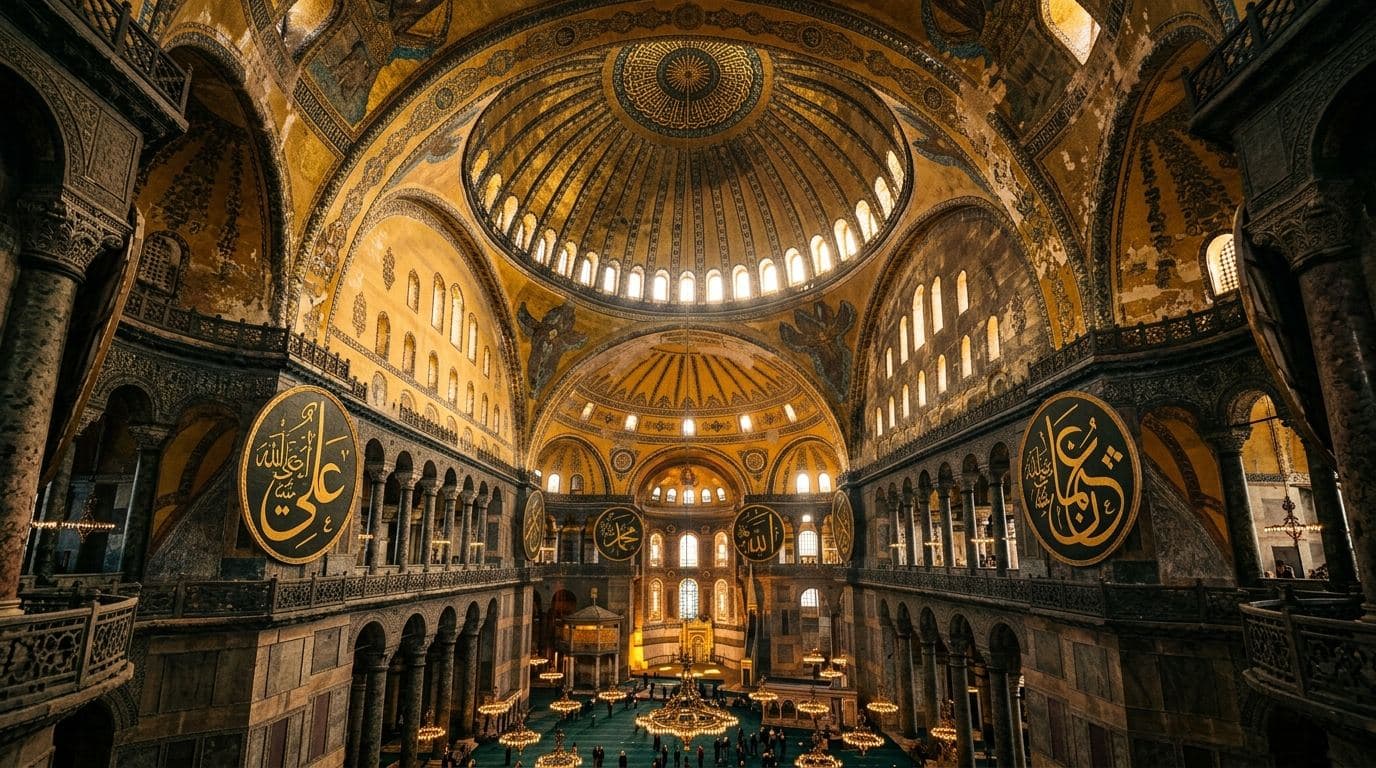
Inside Hagia Sophia, foreign visitors now explore from the upper gallery, on a dedicated route that circles above the prayer hall rather than through it. The system began on 15 January 2024: the ground floor is reserved for worship, while the gallery route puts you at eye level with the finest mosaics and gives you the best view of the dome anywhere in the building. Honestly, it’s a better vantage point than the old ground-floor shuffle ever was.
The Hagia Sophia interior rewards slow looking, and knowing what you’re walking toward helps. Here’s the route roughly as you’ll experience it, from the first look over the parapet to the mosaic that ambushes you on the way out.
How the Visit Works Now
Tourists enter through a separate visitor entrance on the southwest side of the building, away from the worshippers’ doors. Entry costs €25 at the gate for foreign visitors, children under 8 go free, and the route runs entirely along the upper gallery. You keep your shoes on up there, since you never step onto the prayer carpets, but this is still a working mosque: shoulders and knees covered for everyone, and women should carry a light headscarf. Our dress code guide has the full rundown.
One more thing to know before you queue: tourist entry pauses for roughly 30 to 60 minutes around each of the five daily prayers, with the longest break around Friday midday.
What to See Inside Hagia Sophia: The Short List
If you remember nothing else, remember these: the dome from the gallery rail, the Deesis mosaic in the south gallery, the omphalion glowing in the carpet far below, the giant calligraphic roundels, and two oddities most people walk straight past, a runic scribble left by a Viking and the grave marker of a Venetian doge. Everything below follows the order you’ll likely meet them in.
The First Look Over the Parapet
The moment you reach the gallery level and step to the rail, the building does its trick. The nave opens up beneath you, vast and gold-lit, and the dome, about 31 metres across with its crown some 55 metres above the floor, hangs overhead on a ring of forty windows. On the pendentives, the four curved triangles carrying the dome, you’ll spot the six-winged seraphim; one had its face uncovered during a 2009 restoration and gazes back at you. How all of that stays up is a story of its own, told in our architecture guide.
Give this first stop time. The light changes minute by minute as clouds cross the windows, and no photo quite captures the scale.
The South Gallery: Where the Treasures Cluster
Work your way around to the south gallery and the pace slows, because this is where the best of the mosaics live. The Deesis, made around 1261, shows Christ Pantocrator flanked by the Virgin Mary and John the Baptist, and many art historians rank it as the finest Byzantine mosaic anywhere, even with its lower half lost. Nearby hang the two imperial panels: Christ with Emperor Constantine IX Monomachos and Empress Zoe, the emperor’s head famously reworked when Zoe remarried, and the Komnenos panel of 1122, showing the Virgin and Child with Emperor John II Komnenos and Empress Irene.
The gallery holds quieter curiosities too. The Marble Door, a carved stone doorway, stands between gallery bays. A parapet bears faint 9th-century runic graffiti reading “Halfdan,” scratched by a Viking who was evidently bored during a service. And set into the floor is the grave marker of Enrico Dandolo, the doge of Venice buried here after the Fourth Crusade of 1204.
Looking Down: The Nave from Above
Between mosaics, keep drifting back to the rail, because the ground floor tells its own story from above. The omphalion, a circle of coloured marble discs where Byzantine emperors were crowned, has been left uncovered within the prayer carpet and reads beautifully from the gallery. The eight calligraphic roundels, each about 7.5 metres wide and painted in the 1840s, name Allah, the Prophet Muhammad, the four caliphs, and the Prophet’s grandsons Hasan and Husayn. In the apse, the Virgin and Child mosaic of 867 looks down the length of the nave, though curtains conceal it during prayer times. You’ll also pass the Loge of the Empress, marking where the empress once followed services from this level.
Watching worshippers move quietly across the carpet below is part of the experience now. This isn’t a museum diorama; the building is doing the job it has done, in one faith or another, for nearly 1,500 years.
What’s on the Ground Floor You Can’t Reach
Two famous sights now sit on the worship floor, off the tourist route. The Wishing Column, also called the Weeping Column, stands in the northwest aisle with its brass sheath and thumb-worn hole; generations rotated a thumb in it for luck, but it’s on the prayer side today. The huge marble lustration urns, brought from Pergamon, are down there too. Worshippers entering for prayer can see both up close, which is free; from the gallery, content yourself with the view from above.
Timing the Interior at Its Best
The gallery route runs daily from about 09:00 to 19:00, with last entry roughly an hour before closing and those prayer-time pauses throughout the day. Avoid Friday between about 11:30 and 14:30, when the midday Jumu’ah prayer keeps the doors closed longest, and remember the apse mosaic disappears behind curtains during every prayer. Our plan your visit page pulls the timing, entrances and nearby sights together. When your day is fixed, reserve your entry slot in advance and walk past the line at the gate.