
15 Fascinating Hagia Sophia Facts
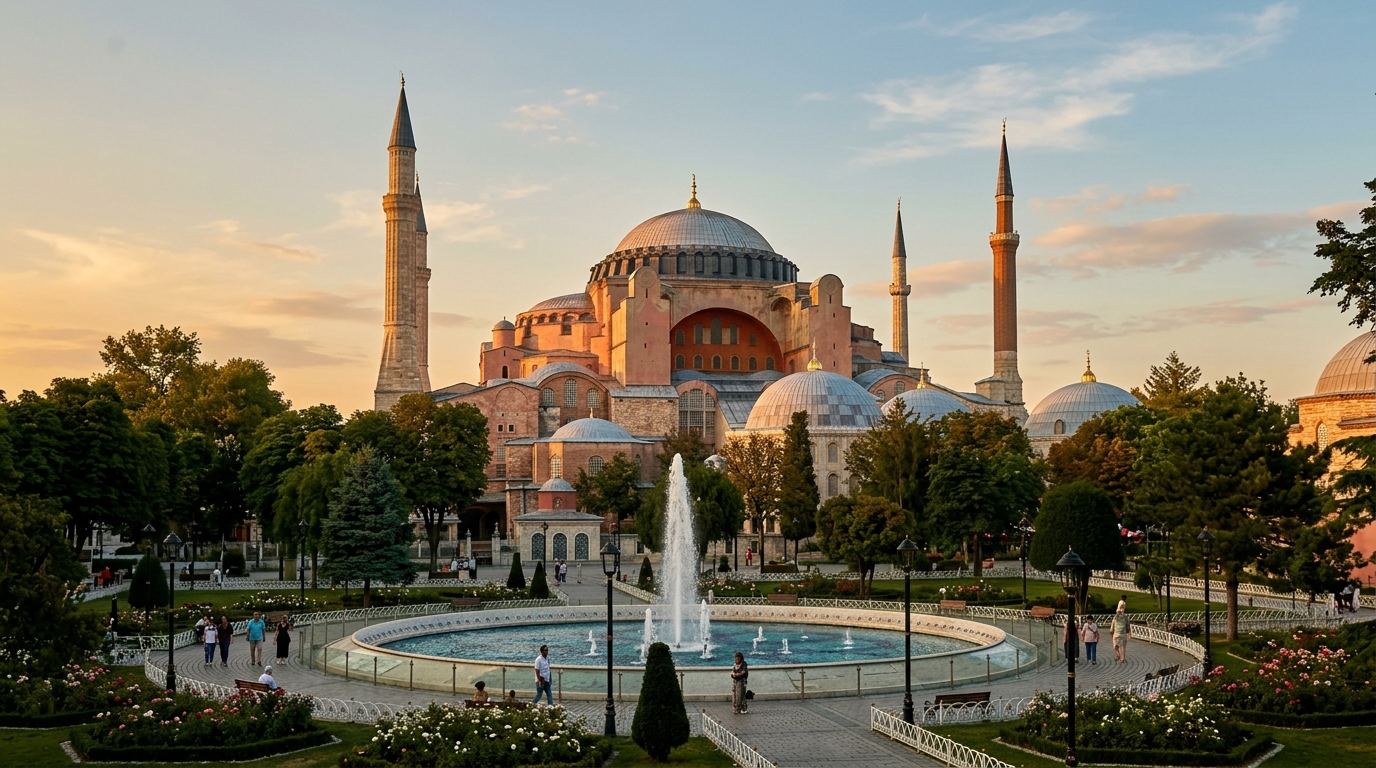
The best Hagia Sophia facts read like fiction: a dome raised by two scientists in under six years, Viking graffiti in the gallery, a Venetian doge buried upstairs, and a building that has been a cathedral, a mosque, a museum and a mosque again. Nearly 1,500 years after its inauguration, it remains Istanbul’s most extraordinary structure, and the numbers behind it are as strange as the history. Here are fifteen facts worth knowing before you stand under that dome.
15 Hagia Sophia facts worth knowing
1. It was built in under six years
Emperor Justinian I’s builders finished the enormous church in five years and ten months, by tradition, between 532 and 537 AD. It was inaugurated on 27 December 537. For a structure this size, in the 6th century, that speed is almost as impressive as the building itself.
2. Its architects were scientists, not builders
Justinian didn’t hire master masons. He hired Anthemius of Tralles, a mathematician, and Isidore of Miletus, a geometer and physicist. Hagia Sophia is what happens when theorists are handed an imperial budget, which may explain both its daring and fact number four below.
3. It was the world’s largest cathedral for about 1,000 years
From 537 until Seville Cathedral overtook it in 1520, nothing in Christendom matched it. For roughly a millennium, walking into Hagia Sophia meant walking into the largest cathedral on Earth.
4. The dome collapsed, and was rebuilt higher
Earthquakes brought part of the first dome down in 558. Isidore the Younger, nephew of the original geometer, rebuilt it about 6 metres higher and steeper, finishing in 562. After further partial collapses in 989 and 1346, today’s dome is a patchwork of 6th, 10th and 14th-century work. How it stays up at all is the subject of our architecture guide.
5. Forty windows make the dome look like it floats
A ring of 40 windows circles the dome’s base, matching its 40 ribs. Light pours through the ring and visually severs the dome from the building below, creating the famous illusion that it hangs in the air. The crown sits about 55.6 metres above the floor.
6. A Viking scratched his name into the gallery
On a parapet in the gallery, a 9th-century Norse visitor carved runes reading “Halfdan.” A Viking, probably a mercenary in the imperial guard, got bored during a service and left the medieval equivalent of “Halfdan was here.” It’s still there.
7. A doge of Venice is buried upstairs
Enrico Dandolo, the doge who steered the Fourth Crusade into sacking Constantinople in 1204, died in the city and was buried in Hagia Sophia’s upper gallery. His grave marker survives on the visitor route, a strange guest in the building his crusade looted.
8. Emperors were crowned on a circle of marble discs
The omphalion, a set of coloured marble discs inlaid in the ground floor, marked the spot where Byzantine emperors were crowned. It’s still visible today, deliberately left uncovered within the prayer carpet laid after 2020.
9. The calligraphic roundels are about 7.5 metres wide
The eight giant medallions hanging in the nave were created in the 1840s by the calligrapher Kazasker Mustafa İzzet Efendi. Each about 7.5 metres across, they carry the names of Allah, the Prophet Muhammad, the four caliphs, and the Prophet’s grandsons Hasan and Husayn.
10. It spent 85 years as a museum
Under Atatürk, a 1934 decree secularized the building and it opened as a museum on 1 February 1935. The museum era lasted until 2020, when Turkey’s Council of State annulled the decree. The full church-mosque-museum-mosque timeline is on our history page.
11. The seraphim got their faces back in 2009
Four six-winged seraphim occupy the pendentives beneath the dome. Their faces were covered during the Ottoman era; a 2009 restoration uncovered one, so a single seraph now gazes down with a face, while its companions keep theirs hidden. They’re best seen from the gallery, along with the Byzantine mosaics.
12. Two Swiss-Italian brothers saved the mosaics’ record
The Fossati brothers restored the entire building in 1847–1849 for the sultan. They uncovered, carefully documented, and then re-covered many of the Christian mosaics, creating the archive that later restorers used to find them again.
13. The name doesn’t mean “Saint Sophia”
Hagia Sophia is Greek for “Holy Wisdom”: the church was dedicated to Christ as the Wisdom of God, not to any saint named Sophia. The mix-up came from the Latin Sancta Sophia. The full story is in our piece on the name’s meaning and pronunciation.
14. It’s a UNESCO World Heritage Site
Hagia Sophia was inscribed in 1985 as part of the Historic Areas of Istanbul World Heritage Site, alongside its Sultanahmet neighbours, Topkapı Palace and the Blue Mosque among them.
15. It’s still an active mosque today
Since 24 July 2020, Hagia Sophia has been a working mosque again, the Hagia Sophia Grand Mosque. Worshippers pray on the ground floor free of charge, while foreign visitors explore a dedicated upper-gallery route introduced in January 2024. At prayer times, curtains briefly conceal the apse mosaic of the Virgin and Child.
Why is Hagia Sophia important?
Because no other building carries this particular stack of history. It’s the high point of Byzantine engineering, the model that shaped Ottoman mosque architecture for centuries, a gallery of the finest surviving Byzantine mosaics, and a living place of worship, all in one shell on one square. Empires rose and fell around it; it just kept adapting.
The facts are better in person. Our plan your visit guide covers timing, entrances and how to pair it with the Blue Mosque across the square, and you can book your visit online to skip the ticket queue and get straight to fact-checking that floating dome yourself.