
The Dome of Hagia Sophia: How It Was Built — and Why It Fell
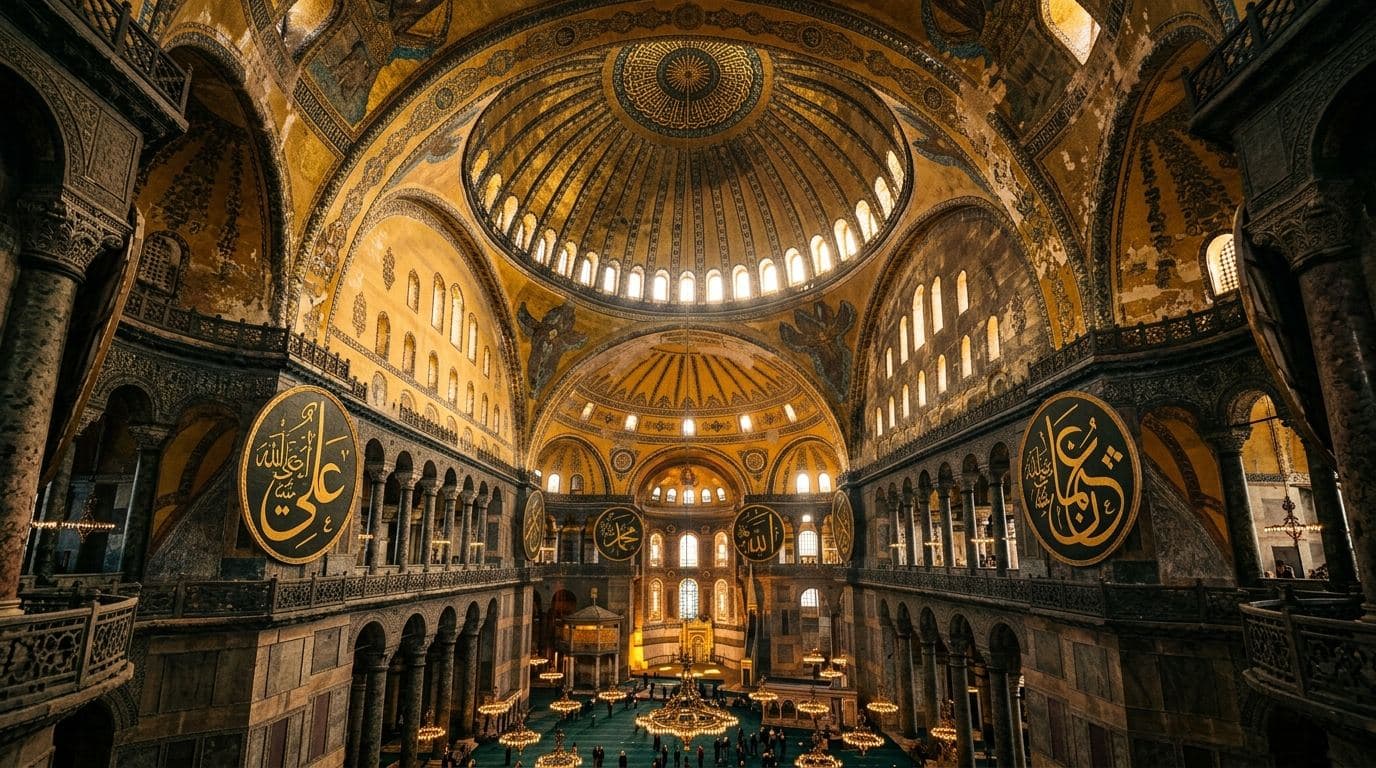
Hagia Sophia’s dome spans about 31 metres and floats roughly 55 metres above the floor, ringed by 40 windows that make it appear to hover on a band of light. When it was completed in 537 AD it was the largest dome in the world — and it stayed that way, in the West, for nearly a thousand years. Here is how it was built, why part of it fell, and the engineering idea that still makes visitors look up in disbelief.
A dome on a square — the pendentive trick
The hardest problem in 6th-century architecture was putting a round dome on a square room. Hagia Sophia’s architects — Anthemius of Tralles, a mathematician, and Isidore of Miletus, a geometer — solved it with pendentives: four curved triangular sections that gather the weight of the dome down onto four massive piers at the corners. It was one of the boldest structural ideas of the ancient world, and it is why the dome seems to sit on nothing at all.
The ring of 40 windows around its base does the rest. Light pours in at the exact line where the dome meets the walls, hiding the stonework in glare — so the dome reads as weightless, “as if suspended from heaven by a golden chain,” as one contemporary writer put it.
Why it collapsed — and came back higher
The first dome was flatter and more daring than what you see today. In 558 AD, just two decades after completion, an earthquake brought part of it down. The repair was handed to Isidore the Younger, nephew of the original architect, who rebuilt it steeper and about six metres higher (completed 562). A steeper dome pushes its weight down more than outward, making it far more stable — the version that has survived, with later reinforcements, for some 1,460 years.
What to look for when you visit
- Stand under the centre and find the ring of windows — that’s the “floating” effect at work.
- Look at the four pendentives in the corners; each carries a giant seraph mosaic.
- Notice the buttresses added over the centuries on the outside — evidence of the constant fight to hold the dome up. Our architecture page has more.
The dome is the reason Hagia Sophia is worth the trip — see why for yourself, and book your entry to stand beneath it.